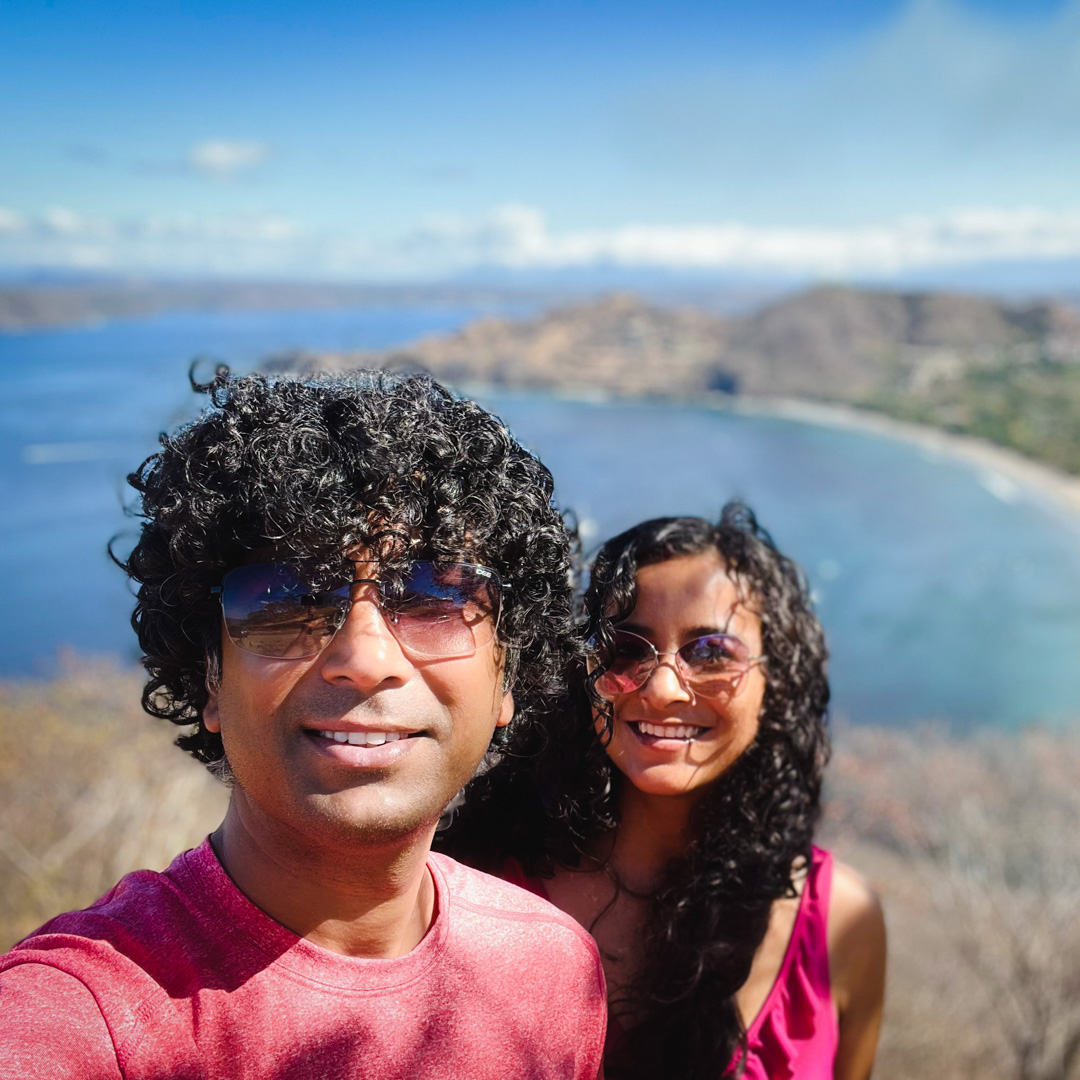
The crisp morning air welcomed us as we stepped outside our accommodation in Bogota, excited for our day of exploration ahead.
We had booked a day tour to visit two of Colombia’s most fascinating attractions in a single day: the mystical Guatavita Lake where the El Dorado legend was born and the underground marvel of Zipaquira Salt Cathedral.
The tour vehicle, a comfortable minivan had already arrived a few minutes before our scheduled pickup time. Our guide Sergio and driver Andres greeted us with warm smiles and friendly welcome that set the tone for what would become one of our favorite experiences in Colombia.
In this blog post, we share our personal experience of going on this day tour from Bogota, and everything you need to know to plan your own visit to Guatavita Lake and Zipaquira Salt Cathedral.
Guatavita Lake and Zipaquira Salt Cathedral Tour: A Quick Overview
🎟️ Which Tour to Book?
We went on this Guatavita Lake and Zipaquira Salt Cathedral Tour from Bogota and had a great experience.
✨ Tour Highlights: Visiting two spectacular attractions, combining history, culture, nature in one day:
- Guatavita Lake: the birthplace of the legend of El Dorado
- Zipaquira Salt Cathedral: an underground marvel
🕰️ Tour Timing and Duration: Pickup starts from 8:00 am. Duration is 12 hours, subject to traffic conditions.
✅ Tour Inclusions:
- Hotel pickup and drop-off
- Transportation in a minivan
- Services of a driver and an English-speaking bilingual guide
- Entrance tickets to Guatavita Lake and Zipaquira Salt Cathedral, if you select the option
📌 Pin this for later

Why Choose this Tour?
We wanted to include Guatavita Lake and Zipaquira Salt Cathedral in our Bogota trip itinerary.
So, we chose this Guatavita Lake and Zipaquira Salt Cathedral tour from Bogota because of an efficient tour itinerary that takes visitors to both the places, without needing us to figure out the transportation logistics.
There are some other aspects too, that we enjoyed after joining the tour.
Read on for our detailed view of why to choose this tour from Bogota.
After considering and comparing various options of guided tours and independent visits to these places, we finally settled on this specific day tour by Beyond Colombia that allowed us to visit both the attractions in one day. At the end of the tour, we were happy with our decision.
Here are some of the things we liked about our day and the reasons we think you can choose this tour to visit Guatavita Lake and Zipaquira Salt Cathedral.
Itinerary Design
We loved this day tour from Bogota as it packed into one efficient itinerary, two of Colombia’s most significant attractions representing natural beauty, cultural history and architectural wonder.
There was a good balance of guided information and free time to explore.
Sergio, our guide provided historical and cultural context at each location, and we also had opportunities to wander on our own, take photos and absorb the atmosphere, without feeling rushed.
Spectacular Places to Visit
Guatavita Lake is not just stunning views of an emerald-green crater lake surrounded by rolling hills. This is where the famous legend of El Dorado originated, and the mystical atmosphere of the place beautifully complemented the stories we heard from our guide.
Zipaquira Salt Cathedral represents a fusion of faith, art and engineering. Built 180 meters underground within an active salt mine, this cathedral is not just a place of worship but a testament to human creativity and ingenuity.
In addition to these two key attractions, we also had the chance to check out some other places. We are going to write about all of that in the detailed tour description.

Convenience of Logistics
It is possible to visit the Zipaquira Salt Cathedral and the Guatavita Lake on your own. However, given the public transport connectivity among Bogota, Zipaquira and Guatavita, you will need two different days to visit the two places on your own.
One day, you can take the bus from Bogota to get to Zipaquira and visit the Salt Cathedral. Another day, you can take another bus from Bogota to get to the town of Guatavita. From the town, you will need to arrange for some mode of local transportation to get to the lake.
By going on this tour, you eliminate the hassle of all that transportation logistics, as well as save time.
Tour Dynamics
We liked that, although the itinerary looked busy on paper, this long day trip was actually pretty relaxing.
From the moment we met Sergio, he started chatting like an old friend, creating a comfortable environment for us.
He prompted all tour participants to share their travel stories from Colombia and also encouraged us to ask any questions about traveling in Colombia. This created a nice camaraderie among all the tour participants and the guide, and we all bonded as a group throughout the day.
Our driver Andres didn’t speak English. But once he figured that Indranil and I speak Spanish, we shared many moments of hearty laughs throughout the day.

How to Book the Tour
🎟️ You can book the Guatavita Lake and Zipaquira Salt Cathedral Tour here →
⏰ To accommodate for change in travel plans, it allows free cancellation for up to 24 hours before the tour.
Here are a few things to note before you book the tour:
(1) We recommend booking a few days in advance, particularly during high season (December-January and July-August), as this popular tour can fill up quickly.
(2) When booking, you will need to provide your Bogota accommodation details for pickup. The tour operator will confirm your exact pickup time (typically between 8:00am-8:30 am) the day before your tour via email or WhatsApp.
(3) Add your WhatsApp contact as this is the preferred mode of communication in Colombia, and most of Latin America, and also, this will help you stay in touch with your guide in real time, when needed.
(4) Do not book this tour for a Monday because Guatavita Lake is closed on Mondays. The tour does operate all days of the week though.
Check the availability of tour here:
Guatavita Lake and Zipaquira Salt Cathedral: Our Personal Experience of the Tour
Here is the detailed breakdown of our day visiting Guatavita Lake and Zipaquira Salt Cathedral, from the time we were picked up from our accommodation in Bogota until we were dropped back.
Journey Begins
As we left Bogota behind, the landscape transformed gradually. The urban sprawl gave way to lush green farmlands, with the Andean mountains creating a dramatic backdrop.
Sergio, our guide, used this drive time for conversations and for sharing his insights about Colombian life and the regions we were passing through, pointing to interesting features.
Our first stop was a quirky, colorful house that was upside-down, called La Casa Loca. So, it made for a perfect photo opportunity. This brief stop also helped break up the journey and allowed us to stretch our legs for a bit.

Guatavita Town
After about two hours since pickup, we arrived at the picturesque town of Guatavita. Interestingly, this is not the original settlement. The old town of Guatavita was flooded when a dam was built in the 1960s, and in fact, we saw that manmade reservoir on the way here.
The new Guatavita is a planned community with distinctive whitewashed houses with terracotta roofs that give it a uniquely uniform appearance, and help retain some of the visual characteristics of the original town.
After the long journey, this stop was a also much needed bathroom break for everyone. As people took turns, we used this time to get some coffee (tinto in Colombia) from a small shop and to chat with Sergio and our driver, Andres.
This is when Andres discovered that Indranil and I can make conversations in Spanish. He was delighted! He was excited to chat with two people from India, and was proud to share with us his recommendations about Colombia.
After the break, our group moved to the main square of Guatavita town, where Sergio shared with us the area’s history and significance. We then spent some time strolling on our own, admiring the architecture and soaking in the peaceful feel of the town, before continuing our journey to the legendary lake.

Guatavita Lake
Entry and Time Slots
From the town, we drove a short distance to the entrance of the Guatavita Lake natural reserve.
Upon procuring the entrance tickets, our tour group was allotted a time slot for starting the hike. The entry time slots are defined to probably space out the groups of people over time and trail length.
Guatavita Lake authorities offer Spanish speaking guides to give tours at these designated time slots. Sergio said that we would let this group take the lead, and our group would follow them, maintaining a good distance, with Sergio guiding us in English.
When booking, you can choose between 2 options: without or with entrances included.
If you select the tour option without entrances included, you have to buy the ticket at the natural reserve.
🎟️ For foreigners, Guatavita Lake entrance ticket costs 29000 COP per person for adults, and 14000 COP per person for seniors (over 62 years).
Hiking to the Emerald Waters
At the stipulated time, we began our hike up the mountain path. As we climbed higher, we often paused to look back and enjoy panoramic views of the valley and the surrounding green mountains.
Although consistently uphill, we found the trail to be fairly easy.
The only challenge could be that since you are hiking to an altitude of 3000+ meters, breathing may become difficult in the thin air with lower oxygen.
So, let’s say the Guatavita Lake hike is of moderate difficulty level.
It was perfectly manageable for our mixed-age group, with several stops along the way where Sergio shared fascinating stories about the Muisca people who once considered this lake sacred.
As we climbed higher, Sergio explained us the famous legend of El Dorado.

The Origin of El Dorado Legend
Sergio told us how the Muisca tribe would perform elaborate ceremonies after choosing a new leader. The chosen one would be covered in gold dust and sail to the center of the lake on a raft, where he would throw gold and emerald offerings into the water as a sacrifice to the gods.
This ritual gave birth to the legend of El Dorado that later sparked centuries of treasure hunting and exploration by the Spanish conquerers.
But not just the ceremonies after choosing the new leader, Sergio also told us stories of what process the chosen one had to go through to prove if he is a capable leader, and how his wife was selected.
What stood out to us was the powerful angle about the Muisca women, who were decision makers. For example, the mother of the chosen leader had the responsibility of selecting the wife for her son, and she did this NOT based on the beauty of the contenders, but the selection was made based on skills, intelligence and leadership capabilities.

The Emerald Lake Views
When we finally reached the top, the circular shaped emerald-green lake was impressive on first sight. The unusual round shape of Guatavita Lake adds to its mystical quality.
From here, there are 3 different viewpoints, and you get views of various perspectives from each. The circular shape of the lake is most prominent from the third viewpoint.
Due to its shape and position, we assumed the Guatavita Lake to be a volcanic crater lake. But Sergio explained that although that was one of the early theories, it was discarded with sufficient proof, and told us about the other theories and the related evidences.
We spent about 30 minutes at the top, stopping at all the viewpoints, taking photos and simply absorbing the tranquil atmosphere, while Sergio continued sharing stories of how treasure hunters had attempted over the centuries to drain the lake in search of the legendary gold.

Hike Out
The hike back down offered different perspectives of the surrounding landscape. I liked that the trail is not out and back, that is, we followed an onward route to get out of the reserve.
At the end of the trail, we tried a traditional arepa con queso and sampled some chicha, a fermented corn drink that has been part of indigenous cultures for centuries.

Zipaquira Town
After our Guatavita adventure, we drove to the town of Zipaquira, known for its salt mining history.
Before visiting the unique salt cathedral, we explored the charming town center with its impressive main square dominated by the church, Diocesan Cathedral of Zipaquira. No, not the Salt Cathedral yet.
We loved hanging out at the large main square, lined by charming colorful buildings. Sergio suggested we go take a look inside the cathedral because it is beautiful and it isn’t always open. So we went inside, and indeed, the interior looked gorgeous.

Lunch Break
Then we walked a few blocks to a grill restaurant for lunch. Lunch is not included in the tour. You order from the menu and pay at the restaurant checkout directly per your order.
Since the restaurant’s specialty is grilled meat, that is what you would want to order. Depending on your appetite, the meat plate can be quite filling.
Between the two of us, Indranil and I ordered one main course and one appetizer, which worked fine for us.
We got a grilled meat plate of a mix of pork and chicken, and a small plate of chorizo with potatoes. If we had to order again, we would skip the mix with chicken and stick to pork only.

Zipaquira Salt Cathedral
Entrance
The Zipaquira Salt Cathedral, often referred to as the First Wonder of Colombia, was the highlight of our day.
After purchasing our entrance tickets and collecting our audio guides, we bid bye to Sergio temporarily as external guides are not allowed inside the cathedral.
However, you do get an audio guide that is quite elaborate and helps you navigate the attraction step by step. The audio guide is available in several languages, including English.
Before separating, Sergio gave us good suggestions on some key experiences, some of them time bound, that are not to be missed inside the Salt Cathedral.
Just like Guatavita Lake, if you book the tour without entrances included, you need to buy the ticket from the ticket window onsite.
🎟️ Here is the Zipaquira Salt Cathedral ticket prices structure for foreigners:
| Ticket Category | Adult | Child/ Senior |
|---|---|---|
| Basic | 125000 COP | 110000 COP |
| Intermediate | 136000 COP | 122000 COP |
| Premium | 164000 COP | 164000 COP |

The Underground Marvel
Located 180 meters underground inside an active salt mine, the architectural and artistic achievement of the Zipaquira Salt Cathedral left us speechless.
This cathedral isn’t just a tourist attraction but a functioning place of worship that can accommodate thousands of people.
As we descended into the mine, the temperature dropped noticeably, and the air took on the distinctive scent of salt.

Series of Chapels
Through the hallway, we walked by a series of small chapels representing the Stations of the Cross, each dramatically lit with colored lights that created an otherworldly atmosphere.
The intricate details of the salt-carved platforms and crosses were all the more impressive knowing that they were sculpted from the mine itself.

Main Cathedral Space
After the series of chapels and a dome, we arrived at the main cathedral space. It features narrow tunnels connecting three naves, representing the birth, life and death of Jesus.
The dramatic use of light throughout the cathedral creates shadows and highlights that enhance the spiritual atmosphere.
The largest cross stands 16 meters tall and is illuminated with light that seems to make it float in the darkness.
Sergio had explained us that a few minutes before every clock hour, the lights go off in the nave, and then as the clock strikes the hour, it’s a little show of the lights coming on gradually, illuminating the space in a surreal glow. For sure, we didn’t miss this one!

3D Movie
At the end of the audio guided tour of Zipaquira Salt Cathedral, we were directed to the layout of what lied next.
Next for us was watching a short 3D animation movie about the history of the salt mines, learning how the Muisca people were the first to extract salt here centuries ago.
The film provided context that deepened our appreciation for both the natural and human-made wonders we had experienced during the day.

Water Mirror
As we walked towards the exit, we checked out the Water Mirror and the commercial area with souvenir shops and eateries and cafes.
The water mirror is a shallow pool of brine, that is, salt dissolved in water. Working with the magical lighting, this pool reflects salt rock ceiling with near-perfect clarity.
I honestly thought it was solid floor and had to look twice to realize it was water!

Souvenir Shops and Train
The setup of the souvenir shop looked pretty, and the articles for sale also looked interesting. Most of the eateries were already closed by the time we passed by them. (We were some of the last people to leave).
Now, to get from this commercial area of the Salt Cathedral to the parking area, we boarded the “train”. It is actually an on-road vehicle provided by the Cathedral, and it acts like a fun train, making sounds of train whistles occasionally.
All of us in the group finally met Sergio and Andres, who were already waiting near the parking area in the vehicle.
Book the Tour here →
Returning to Bogota
As the day drew to a close, we boarded our van for the return journey to Bogota. The drive back took about an hour and a half, and we arrived after dark, tired but thoroughly satisfied.
Tips to Make the Most of Your Tour
Here are our suggestions on what to wear, what to bring, and some other planning tips to help you make the most of your Guatavita Lake and Zipaquira Salt Cathedral day tour from Bogota:
What to Wear:
- Comfortable walking shoes for the Guatavita Lake hike
- Layered clothing (the weather can change quickly in the Andean region)
- Light rain jacket or poncho, especially during rainy season
- Sunscreen, sunglasses, hat
What to Bring:
- Camera or phone camera with enough storage (you will find plenty of photo opportunities)
- Small daypack for personal items
- Drinking water in reusable bottle
- Cash for small purchases
- Light snacks for the long journey
Physical Considerations:
The Guatavita Lake hike involves walking uphill at a high altitude (around 3,000 meters). Take it slow if you are not acclimatized to Bogota’s elevation.
The Salt Cathedral visit involves walking on sometimes uneven surfaces and many stairs, though the pace is leisurely.
Language: While the tour is conducted in English, learning a few basic Spanish phrases will enhance your experience, especially when interacting with locals at stops along the way.
Photography: Photography is permitted throughout the tour, including inside the Salt Cathedral (without flash). The lighting conditions underground can be challenging, so adjust your camera settings accordingly.

Is the Tour Worth It?
Yes! Our day trip to Guatavita Lake and Zipaquira Salt Cathedral with Beyond Colombia exceeded our expectations.
The combination of natural beauty, fascinating history and architectural wonder made for a perfectly balanced day of exploration. Sergio’s knowledge and enthusiasm brought the sites to life, while Andres ensured our journey was comfortable and safe throughout.
If you are visiting Bogota and have time for just one day trip, then go for this Guatavita Lake and Zipaquira Salt Cathedral tour.
We feel, this tour is not just about seeing interesting places, but it is also about understanding the stories and cultural contexts that make Colombia such a fascinating destination.
Book the Tour here →Plan Your Bogota Trip
- Bogota Itinerary
- Where to Stay in Bogota
- How to Get from Medellin to Bogota
- Tips for Visiting Monserrate
We were partially hosted on this tour by Beyond Colombia. However, all opinions, observations and recommendations about the tour, in this article as well as in all our published media about the tour, are our own.
If you enjoy reading our free travel guides, tips and stories, you can buy us a coffee and help us create more such travel planning tools for you. Thanks for supporting Paradise Catchers.
Travel Resources
- Flights: Skyscanner
- Hotels: Booking.com | Expedia
- Tours: Viator | GetYourGuide
- Travel Insurance:
- Heymondo (get 5% off)
- SafetyWing Nomad Insurance
- eSIMs:
- Transfers: Bookaway. Code PARADISE5 for 5% off
Disclosure: Please note that this post may contain affiliate links. If you make a purchase or a booking through these links, we may earn a commission at no extra cost to you. Thank you.